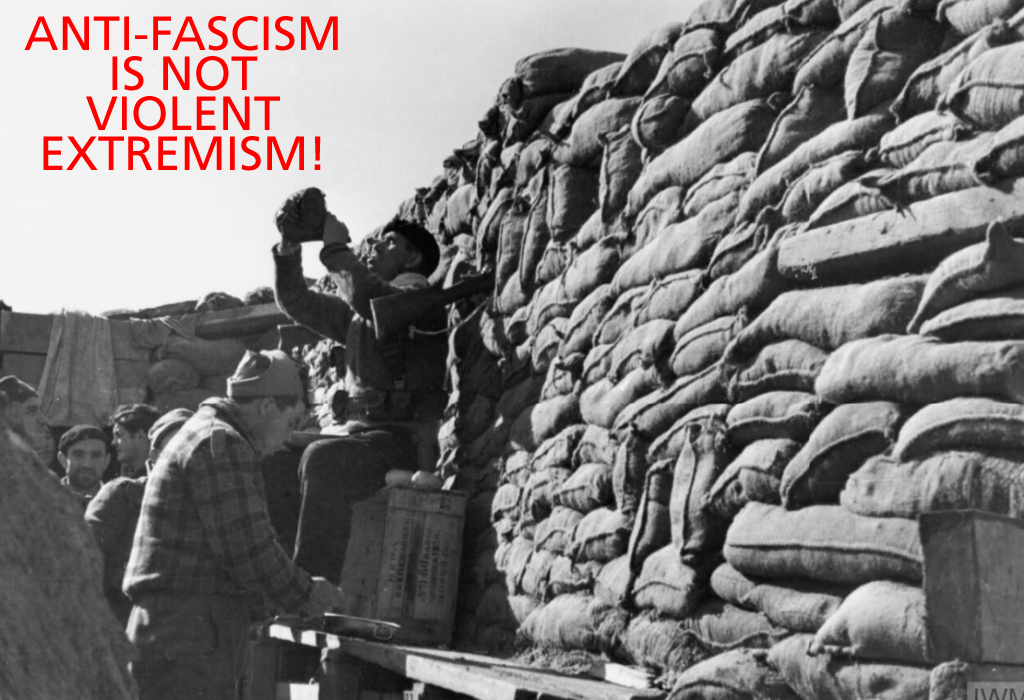
The U.S. Department of State recently designated four extremist groups as “Antifa” terrorist organizations. The headlines in center-left and center-right press fell for the rhetorical trap of insinuation by association. If we don’t catch it we’re at risk of losing this crucial distinction: Anti-fascism is not the same thing as violent extremism.
Anti-fascism is an explicit building block of centrist political consensus in Europe, and I feel a need to point this out to American friends in hopes of catching you before the current U.S. government’s anti-anti-fascist narrative traps you. You do not have to defend violent extremism to defend anti-fascism. But you wouldn’t know that if you saw only these headlines.
On the surface, there is little to object to in the State Department’s new designations. The Italian Informal Anarchist Federation uses explicitly insurrectionist rhetoric, and its associates were involved in a string of destructive and violent acts against mainstream political parties and EU institutions. The Greek Armed Proletarian Justice claimed responsibility for planting a C4 time bomb on a public street near a police station in 2023. Members of the Organization for Revolutionary Self-Defense, also Greek, staged several well-armed drive-by shootings and committed game shop burglaries and a high-profile bank robbery in the name of fomenting international revolution. German members of Antifa-Ost, also known as Hammerbande, carried out several carefully-planned vigilante assaults with hammers and blackjacks, and aerosols in eastern Germany and Hungary.
All four groups committed violent acts and therefore deserve their place on a sanctions list; their anti-fascist stance is immaterial. Three of these groups justify their violent acts with an incoherent mash-up of insurrectionist, anarchist, Marxist, statist, anti-statist, anti-capitalist, and libertarian ideas. Only Antifa-Ost explicitly targeted avowed fascists and justified its violence by alleging that the victims were fascists. All four organizations deserve sanction because they are violent extremists, but not because they are anti-fascist.
Keeping this distinction between anti-fascism and violent extremism in mind, the State Department’s press release headline announcing the sanctions should set off alarm bells:
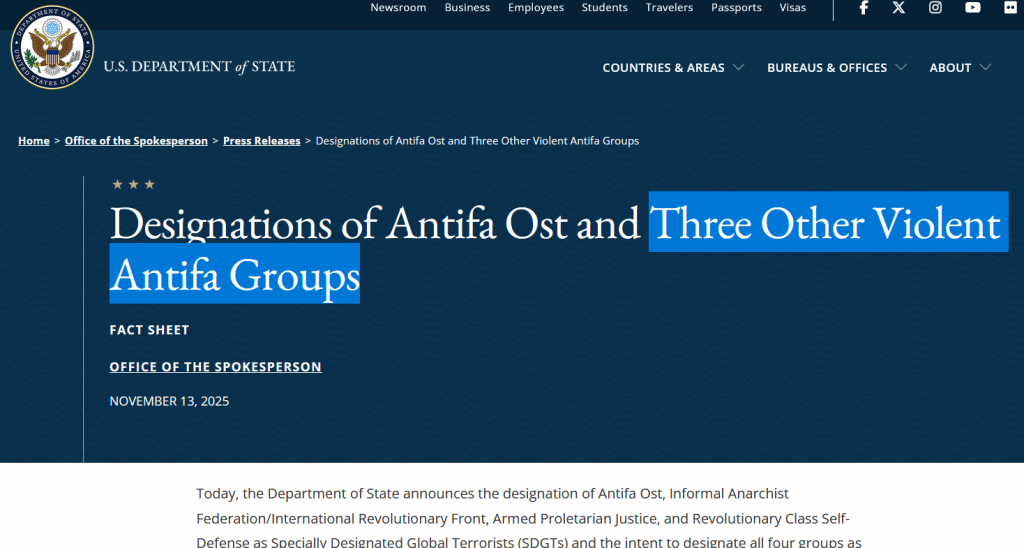
“Three Other Violent Antifa Groups [Plural],” they say. While there is no explicit statement as such, the message is clear. The current State Department aims to deceive the American public into associating anti-fascism with extremist violence. Centrist and right-leaning Americans are the most obvious persuasion targets; exposure to word association is a technique to change public perception. But the left is also at risk — not of believing the ANTIFA = VIOLENCE canard, but of being manipulated into defending indefensible extremist groups, freaking out otherwise-persuadable centrists. By insinuating anti-fascist motives correlate with extremism, the State Department judo-throws the left into defending terrorism, alienating potential allies and fracturing a potentially broad anti-fascist coalition.
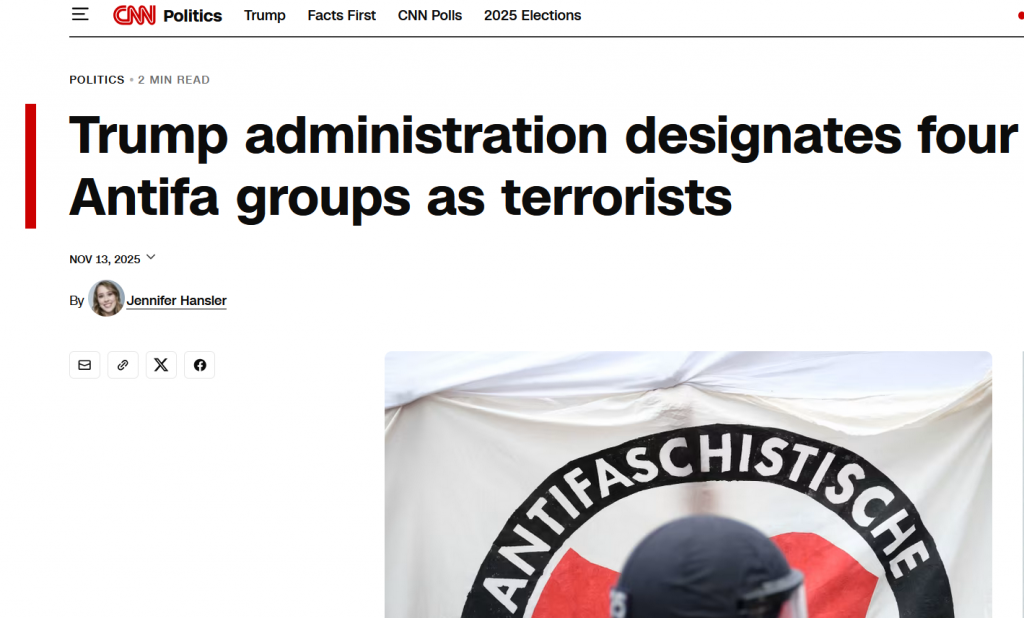
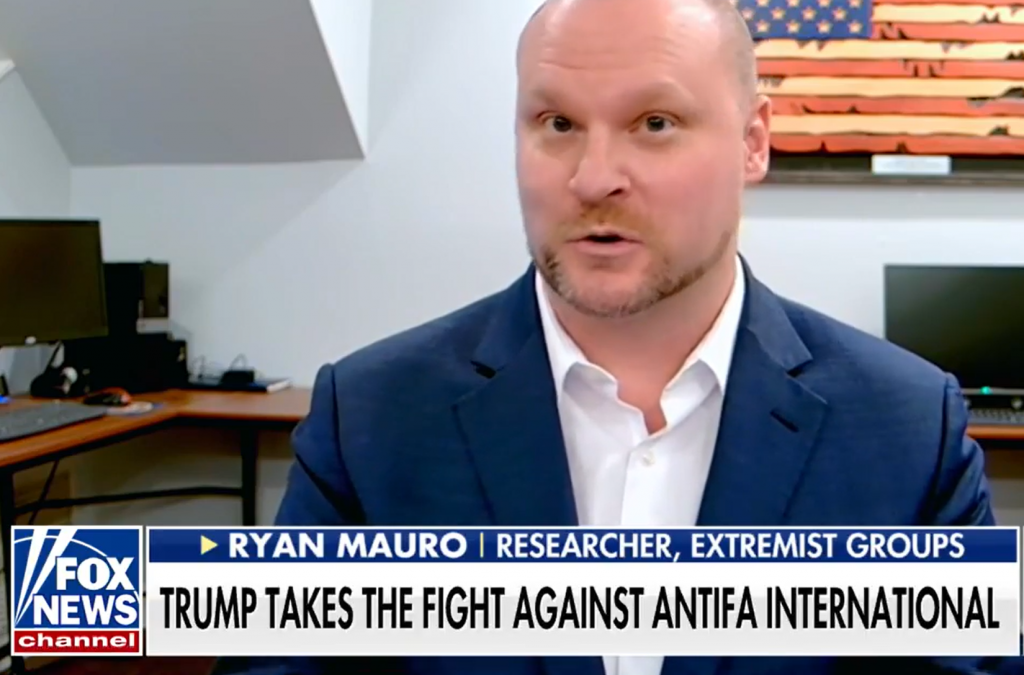
The State Department is only insinuating, not stating directly, that anti-fascism is terrorism. But insinuation is very effective, judging by the speed with which both center-right and center-left media adopted the press release’s framing. Not just Fox and CNN (above) but even the The Guardian refer to anti-fascist “groups,” plural.
Those who hope to oppose the American drift towards authoritarianism should not remain silent while the State Department subtly smears anti-fascism like this. Like all people, someone with anti-fascist commitments can be violent, pacifist, blue, red, black, white, or lime green. An anti-fascist merely objects to dictatorship, rigid social hierarchy, the glorification of power as an end in itself, and the use of violence by a single-party state to suppress opposition. It’s a low bar. The capital-A Antifa banner unites a broad coalition in Europe, from the German equivalent of some normie democrats to Christians to socialists to Zionist weirdos to a delightful group of grandmas. Across the West, including the U.S., most people continue to hold overwhelmingly negative views of fascism. Anti-fascism is a silent pillar of the post-World War II civic order that binds an otherwise ideologically pluralist society together. But it is invisible to us as water is to a fish, and that is a vulnerability. Our society is easier to defend from creeping authoritarianism if we make it bright neon explicit that anyone worthy of civic trust is in some sense an anti-fascist.
If we passively adopt the current State Department’s framing as the press did in late 2025, we are maneuvered into linguistic turf where it’s easy for bad faith actors to conflate normie anti-fascism with extremism, violence, and terrorism. But we can refuse to adopt it ourselves, and we can object loudly when we hear others adopting it. We can start annoying conversations with people every time it comes up. We can and should be cringe about it, because every time we bring it up, we put another sandbag in the social dam that stands between us and the gathering tsunami of authoritarian brainrot headed our way in the coming decades. The brainrot tsunami will be subtle at first, like this State Department press release. We need to be keen to catch it, so let’s practice now while the anti-fascism game’s still on easy mode.